Introduction
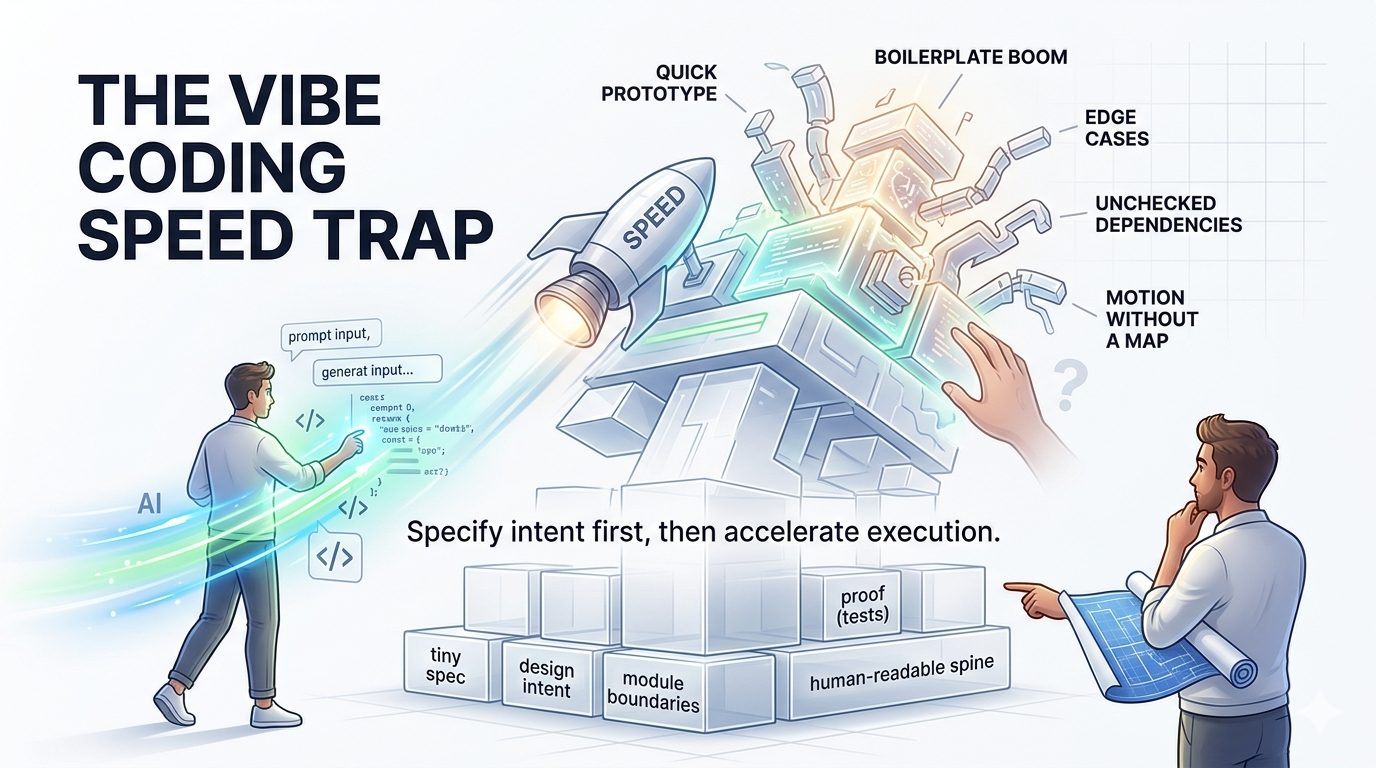
“Vibe coding” is the habit of letting tools—especially AI—carry you from prompt to merge with as little friction as possible. The draw is obvious: ideas turn into running code almost as fast as you can describe them. The problem is that speed without a map is not velocity. It is motion—and motion can hide the fact that nobody on the team, including you two weeks later, can explain why the system behaves the way it does.
This post is not an anti-AI sermon. I use these tools every week. The goal is to separate what vibe coding is good for from the speed trap—the moment the bill arrives in code review, incidents, or that refactor everyone keeps avoiding.
 Fast to type, slow to trust
⚡ What vibe coding gets right
In early exploration, momentum wins. You are not trying to write the final module—you are trying to answer: Is this idea feasible? Does this API feel right? Can we demo something on Monday?
That is where “vibe” shines:
- Boilerplate and glue code stop being the bottleneck.
- You can try three designs in the time you used to spend on one.
- Onboarding to a new library becomes learning by iteration instead of only reading docs.
Used that way, AI is a prototyping multiplier. The trap starts when we confuse the demo with the product—when the same workflow that felt great on day one becomes the workflow for day thirty and production traffic.
🪤 The speed trap
The speed trap has a simple shape: decisions never get made—they get smeared across tokens.
You accept the first suggestion that passes the smoke test. You patch the error the compiler showed without asking if the fix matches the architecture. You add a dependency because the model reached for it, not because you compared alternatives. None of this feels reckless in the moment. It feels efficient.
Then the compile phase of the project ends—and the comprehension phase begins. That is when you discover:
- Edge cases nobody reasoned through, only patched around.
- Inconsistent patterns in the same folder because each file was “vibed” under a slightly different mood.
- A shallow mental model: you can run it, but you cannot justify it in a design review.
 Complexity does not shout—it accumulates
Suddenly the “slow” traditional path—thinking first, typing second—would have been faster in calendar time, because it would have produced less rework and fewer surprise integrations.
🧱 Real drawbacks (the part that shows up in production)
These are the drawbacks that matter once something ships:
Ownership — Code you did not deeply engage with is hard to defend or evolve. The same disconnection people describe with AI-drafted writing shows up in repos: the author name is yours, but the reasoning is borrowed in thin slices.
Reviewability — Pull requests balloon. Reviewers cannot trace intent, so reviews turn into linting and vibes of their own. Nothing durable gets captured.
Security and correctness — Models optimize for plausible code. Plausible is not the same as safe under malformed input, auth boundaries, or concurrency. The failures are not always loud.
Operability — Observability, rollback paths, and failure modes rarely emerge from a pure vibe loop unless you explicitly ask for them—and know what to ask for.
Maintainability — The next person’s job is to read, not to regenerate. If the story is not in the structure, tests, and names, the project pays interest forever.
🛠️ A better way to build (still fast, still AI-friendly)
You do not have to throw away speed. You have to sequence it so the machine accelerates execution, not thinking.
1. Anchor on a tiny spec first — Even a one-pager: goal, non-goals, interfaces, and failure behavior. The spec is what keeps the vibe from drifting.
2. Make the AI a senior pair—on your terms — Paste constraints: stack, patterns, naming, what not to use. Ask for tradeoffs in the answer, not only code. If the model cannot argue the tradeoff, you are not done.
3. Own the seams — Hand-write boundaries between modules, auth, and data. Let automation fill the interior once the shape is stable.
4. Require proof, not vibes — Tests for the scary paths, a typed contract at the API layer, or a checklist you do not skip before merge. Proof turns opinion into inventory.
5. Keep a human-readable spine — Names, folder layout, and one honest ADR beat a thousand clever lines nobody will touch.
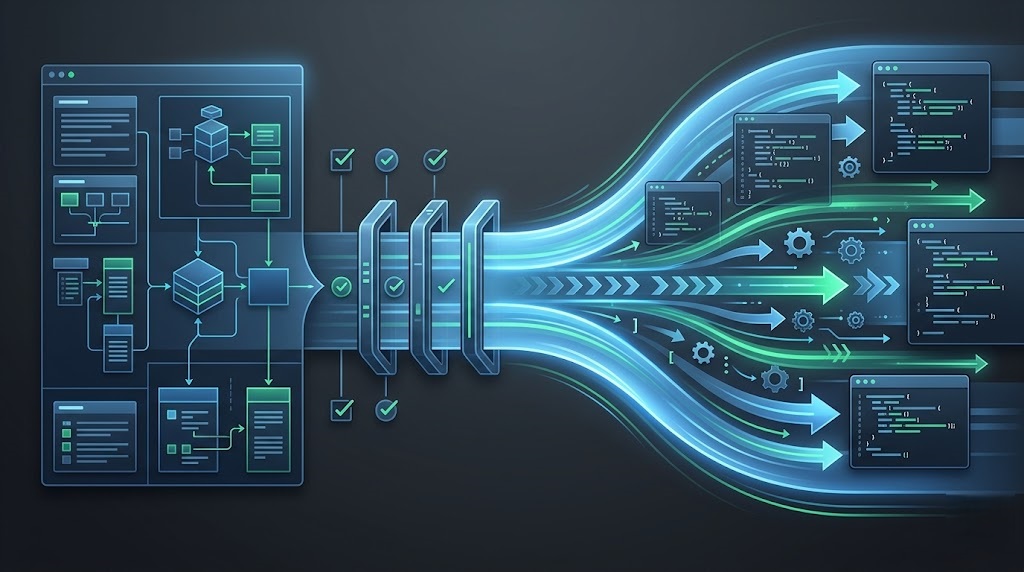 Specify intent—then let tools accelerate execution
Conclusion
Vibe coding is not shameful—it is mis-scoped optimism. There is a world where you ship quickly and sleep well: where AI collapses typing time, but humans retain the narrative, the invariants, and the accountability.
Speed without clarity is debt wearing sneakers. The better workflow is simple to say and hard to cheat: decide what you are building, prove the scary parts, and let the machine help you move—without letting it drive blind.